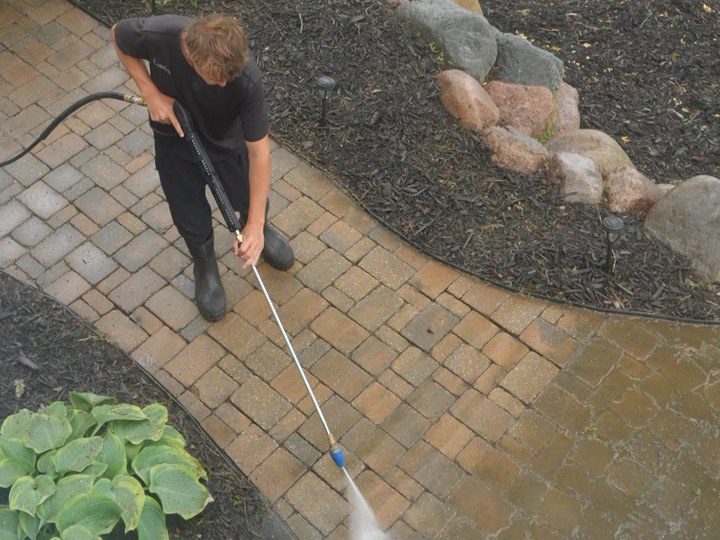
Power Washing in Norwalk.
Driveways, patios, walkways — restored.
JBL Exterior Pros provides power washing for homes across Norwalk, Iowa (50211, Warren County). We adjust pressure to each surface, pre-treat oil stains, and document the work. Insured, in-person quoted, no online estimates.
- Driveway turnaround
- 1–3 hours, 2-car
- Pressure range
- 1,500–3,000 PSI by surface
- Sealer dry time
- 24–48 hours (optional add-on)
Power Washing, the Norwalk way.
Norwalk runs a wider mix than the inner suburbs. The north side and around Echo Valley is 1980s–2010s subdivisions with conventional vinyl siding and asphalt shingles. The rural-edge properties south and west of town are larger-lot homes — some original farmhouses, some 1970s ranches on acreage, some newer custom builds. Brick veneer is more common here than in the newer planned suburbs. A few homes still have cedar shake or T1-11 wood siding that needs the gentlest soft-wash chemistry we run.
Norwalk's lower density means longer drives between jobs and longer runs of fence, deck, and pavement per property. The rural-edge properties carry heavier autumn gutter loads — mature trees plus open field exposure means leaves AND seed pods AND pine needles in one stretch. Pollen drift from surrounding farmland in spring shows on north walls and on solar panels faster than in dense suburban zones. Less HOA control means more independent decisions about exterior maintenance cadence — we see a wider range of property conditions.
Power Washing, in plain English.
Power washing uses high-pressure water — typically 1,500–3,000 PSI — to mechanically lift built-up dirt, organic staining, oil, and grime from hard surfaces: concrete, brick, paver, stone. The pressure dislodges what time and weather have embedded into the porous surface. Power washing is the correct method for hard surfaces only. It is the wrong method for softer surfaces (siding, stucco, painted wood, roof shingles) — the same pressure that lifts driveway grime would strip paint, damage seals, and force water past surface barriers. Knowing what to power-wash and what to soft-wash is half the job.
Central Iowa power washing is its own thing.
Central Iowa concrete and pavement cycle through hard wear every year. Winter road salt embeds in driveways and walkways and leaves a white residue that summer rain doesn't clear. Autumn leaf-stain on porous concrete needs percarbonate pre-treatment to fully lift. Maple and oak tannin staining on patios is the most stubborn organic stain we see in this region. Iowa's freeze-thaw cycle means power-washed surfaces should be done in spring (April–May) or fall (September–October), never in deep summer when concrete is hot enough to flash-dry the treatment chemistry. Driveways in older Beaverdale, Drake, and Sherman Hill neighborhoods are often 60+ years of poured concrete with character cracks; we adjust technique to clean without exacerbating existing damage.
When power washing is overdue.
- Black streaks or dark staining on concrete driveways
- Embedded dirt darkening sidewalks or patios
- Oil or transmission-fluid spots near the garage
- White salt residue (winter aftermath, visible spring)
- Mossy or algae patches on north-facing concrete
- Tannin staining (yellow-brown) from fallen leaves
- Paver joints losing sand or showing weed growth
How a Norwalk power washing visit goes.
- 01
Surface evaluation
We identify the surface type and degree of staining. Some patios need a surface cleaner attachment for even results — we confirm the right approach.
- 02
Pre-treat stains and wash
Oil spots and organic staining get pre-treated. Then a uniform pressure wash across the surface — no striping, no missed sections.
- 03
Rinse and detail
Final rinse, sweep cleanup, and a walk-through. Optional sealer can be applied after the surface dries (24-48 hours).
What we use, what shapes the work.
- Method
- High-pressure water + surface cleaner attachment for even flat-surface results
- Cleaning solution
- Surface cleaners + degreasers for oil; percarbonate pre-treat for organic stains
- Pressure
- 1,500–3,000 PSI depending on surface (lower on pavers, higher on sealed concrete)
- Flow rate
- 4–8 GPM commercial pressure washers (GPM matters more than PSI for cleaning speed)
- Tools
- Surface cleaners (rotating disc), turbo nozzles, controlled-spray wands
Power Washing mistakes other contractors make.
- 01
Using high pressure on pavers
Cranking a residential pressure-washer to maximum on a paver patio lifts joint sand, blasts grout out from between pavers, and over time loosens the entire pattern. Pavers need controlled pressure (1,500–2,000 PSI) and even overlap technique — and often need re-sanding afterward.
- 02
Power-washing siding (or, anything that isn't a hard surface)
The single most common contractor mistake. Power-washing strips paint, damages caulking around windows, voids siding warranties, and can force water behind cladding. Soft washing is the only correct method for siding, stucco, painted wood, and similar surfaces — pressure has no place there.
- 03
Surface-cleaner striping from uneven overlap
A surface cleaner with the wrong overlap pattern leaves visible "stripes" of differently-cleaned concrete — clean areas overlapping with not-clean. Proper technique uses a consistent 30–40% overlap and walking pace.
- 04
Skipping pre-treatment on stubborn organic stains
Tannin staining from oak and maple leaves, set-in oil, and aged mildew won't lift with water pressure alone. Pre-treatment with the right chemistry (percarbonate for organic, degreaser for oil) before pressure-washing is the difference between "cleaner" and "clean."
- 05
Working on hot concrete in summer sun
Surface temperatures above 85–90°F flash-dry treatment chemistry before it can work, leaving streaks. We schedule power-washing for cooler parts of the day or shaded sides of the property when temperatures are extreme.
Power Washing in Norwalk, considered.
01Will pressure washing damage my concrete or pavers?
Not when done right. We calibrate pressure to the surface — pavers get lower pressure to avoid lifting joint sand, concrete can handle more. We adjust the rig setup before starting based on what we see during the walk-through, so the pressure doesn't exceed what the surface can take.02Do you re-sand paver joints after?
Yes when needed. We can re-sand with polymeric joint sand as a separate add-on. We'll recommend it during the walk-through if your pavers need it.03What about oil stains?
We pre-treat them. Old, set-in oil rarely lifts 100%, but most stains improve significantly. We'll set expectations during the quote.04How much does power washing a driveway cost in Des Moines?
Pricing depends on driveway size, surface type (concrete, paver, stamped), and the condition of the staining. Heavy oil and tannin pre-treatment add to the price. We quote in person after seeing the surface — no surprise pricing.05Can I power-wash my wood deck?
We strongly recommend soft washing for wood decks — high pressure raises grain, splinters, and strips stain. Pressure cleaning is fine for the concrete patio next to the deck, but the wood itself should be soft-washed with deck-safe chemistry.06Concrete vs. pavers — different approach?
Yes. Sealed concrete can take 2500–3000 PSI through a surface cleaner. Pavers need lower pressure (1500–2000 PSI) plus careful overlap to avoid lifting joint sand. Stamped concrete sits in between. We adjust the rig setup at the property before starting.07Will it remove paint?
Only if you want it to. Power washing can intentionally remove failing paint as prep for repainting — we set the pressure for that purpose if it's the goal. Otherwise we calibrate pressure to clean without disturbing intact finishes.08When can I drive on it again?
Right away on cleaned concrete and pavers. If we apply a sealer, it needs 24 hours dry time for foot traffic and 48 hours for vehicles. We'll cone the area and confirm the schedule on the day of service.
Ready for power washing in Norwalk?
A JBL rep walks your Norwalk property in person within one business day. Honest pricing, real recommendations, no obligation.
- Power Washing in Des Moines
- Power Washing in Clive
- Power Washing in West Des Moines
- Power Washing in Pleasant Hill
- Power Washing in Urbandale
- Power Washing in Altoona
- Power Washing in Johnston
- Power Washing in Ankeny
- Power Washing in Grimes
- Power Washing in Waukee
- Power Washing in Cumming
- Power Washing in Adel
- Power Washing in Indianola
- Power Washing in Ames